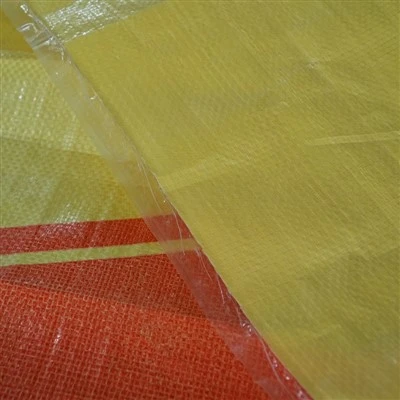

As an exporter of PP woven bags, we frequently encounter the same question from clients: "What material are your bags made of, and is it suitable for my market?" While the question seems simple, the answer determines whether the cargo arrives safely and whether the client places repeat orders.
Different destination climates, cargo types, and end-use scenarios demand vastly different woven bag materials. A correct choice leads to a win-win situation; a wrong choice can result in anything from transit damage to the loss of a client's trust. Drawing on our factory's production experience, this article helps you distinguish between PP and PE and select the most suitable material for your specific market climate.
I. PP vs. PE: Which Material Best Suits Your Order?
PP (polypropylene) and PE (polyethylene) are the two primary raw materials for plastic woven bags. While PP is our standard material for production, understanding the differences between the two helps you make a more informed choice based on your needs.
Polypropylene (PP) - High Strength, High Rigidity, and Lightweight
PP is the mainstream raw material for woven bags in China and our factory's standard choice. Its key advantages include:
Tensile strength of 30–50 MPa: This means heavier loads can be carried with less material, helping you save on packaging costs.
Density of only 0.90 g/cm³: As the lightest of all general-purpose plastics, it results in lower shipping costs for the same quantity of bags.
Excellent heat resistance: With a melting point of 167°C, the bags will not soften or deform, even during long-distance transport inside hot shipping containers.
In short: If you prioritize cost-effectiveness and load-bearing capacity, PP is the ideal choice.
Polyethylene (PE) - Soft and Cold-Resistant, but Lacking Strength
PE is more commonly used for woven bag production in certain overseas regions. Its key advantages are:
Excellent cold resistance; it remains flexible even in extreme cold, with a functional temperature range as low as -70°C to -100°C.
It has a soft, smooth feel, contrasting sharply with the stiffness of PP.
However, PE also has distinct disadvantages: its tensile strength is far lower than that of PP. Meeting the same load-bearing requirements necessitates a thicker bag, which actually results in higher costs. Additionally, it has poor heat-aging resistance, making it more prone to degradation and breakage under high temperatures or prolonged sun exposure.
A quick guide to making the right choice
| Dimension | PP | PE | Our Suggestion |
|---|---|---|---|
| Tensile Strength | High (30-50MPa) | Medium-Low (10-40MPa) | PP for heavy goods |
| Cold Resistance | Moderate | Excellent (-70°C) | Modified PP for cold regions |
| Heat Resistance | Excellent (167°C) | Poor | PP for tropical zones |
| Density | 0.90 g/cm³ | 0.91-0.96 g/cm³ | PP = lower shipping cost |
| UV Resistance | Needs additives | Weaker | UV treatment for both |
II. Which climate zone is your market in? Let us "customize" the material for you.
Many clients ask, "Can your PP bags withstand our local climate conditions?" The answer is: while pure PP is suitable for most scenarios, if your market is in a region with extreme weather, we can modify the material to make the bags more durable.
Regions with high temperatures and intense sun exposure (Middle East, Africa, Latin America, Australian outback)
These regions experience strong sunlight and high UV intensity. Standard PP woven bags degrade under prolonged sun exposure as molecular chains break, leading to a significant loss of strength.
Our solution: We incorporate a composite anti-UV masterbatch (UV stabilizer) during the production of the flat yarn. After modification, the woven bags retain over 80% of their strength following a 144-hour intense light aging test (compared to the industry standard of just 60%). For orders destined for markets like Dubai, Saudi Arabia, Nigeria, and Brazil, we strongly recommend anti-UV treatment; the cost increase is minimal, yet the bag's service life can be more than doubled.
Regions with extreme cold (Russia, Northern Europe, Canada, Mongolia)
Standard PP becomes brittle in sub-zero temperatures, making it prone to cracking during handling and stacking. If your goods are destined for these regions, our engineers recommend a low-temperature modification strategy:
Blending PE or specialized cold-resistant modifiers into the PP raw material at a specific ratio.
Ensuring the bags maintain sufficient flexibility and impact resistance in temperatures ranging from -20°C to -50°C.
We have already applied this solution to orders for numerous clients in Russia and Canada, with consistently reliable results.
Regions with high humidity and frequent rainfall (Southeast Asia, South America, coastal West Africa)
In hot and humid environments, goods are prone to moisture damage, and the moisture resistance of the woven bag alone may be insufficient.
Our solution: Add a PE film liner inside the PP woven bag to create a dual moisture-proof barrier. This solution is particularly suitable for moisture-sensitive goods such as fertilizers, food-grade powders, and chemicals. It offers a significant boost in moisture protection with only a minimal increase in cost.
III. Want superior printing and brand presentation? Choose lamination
If your products are destined for supermarkets or retail outlets, or if the packaging needs to showcase your brand image, we recommend BOPP laminated woven bags:
- A layer of BOPP (Biaxially Oriented Polypropylene) film is laminated onto the surface of the woven fabric.
- Greatly enhanced printing quality-vibrant graphics, crisp text, and fade resistance.
- Simultaneously improves moisture resistance and durability.
BOPP lamination is virtually standard for brand-name products targeting markets in Europe, the US, Japan, and South Korea. However, if your products are distributed through wholesale markets or construction sites where high-quality printing is not a priority, standard unlaminated woven bags offer a more cost-effective choice.
IV. Material selection recommendations
Based on our export experience, here is a guide to selecting materials for different markets and types of goods:
| Cargo Type | Recommended Material Solution | Target Markets (Examples) |
|---|---|---|
| Cement, Fertilizer, Feed (Heavy Loads) | Pure PP woven bags, with UV treatment for high-sunlight regions | Middle East, Africa, Southeast Asia |
| Grain, Food-Grade Powders, Chemicals (Moisture-Sensitive) | PP woven bags with PE inner liner | Southeast Asia, Coastal South America |
| Supermarket Retail, Brand Display (High-Quality Printing Required) | BOPP Laminated PP Woven Bags | Europe, USA, Japan, South Korea |
| Goods Destined for Extreme Cold Regions (Cold-Sensitive) | Low-Temperature Modified PP | Russia, Nordic Countries, Canada |
One final point
As a manufacturer, we do more than just produce and ship bags-we aim to help you minimize issues and losses in your target market. The next time you request a quote, please let us know:
"Which country is the shipment going to? What goods will be packed inside? What is the final application scenario?"
Based on this information, we will recommend the most suitable material solution. That is the true value we offer as a direct manufacturer.